
Integrating M3E Embedding Model
Integrating the private M3E embedding model with FastGPT
Introduction
FastGPT uses OpenAI's embedding model by default. For private deployment, you can replace it with the M3E embedding model. M3E is a lightweight model with low resource requirements -- it can even run on CPU. The following tutorial is based on an image provided by community contributor "睡大觉".
Deploy the Image
Image: stawky/m3e-large-api:latest
China mirror: registry.cn-hangzhou.aliyuncs.com/fastgpt_docker/m3e-large-api:latest
Port: 6008
Environment variables:
# Set the security token (used as the channel key in OneAPI)
Default: sk-aaabbbcccdddeeefffggghhhiiijjjkkk
You can also set it via the environment variable: sk-key. Refer to Docker documentation for how to pass environment variables.
Connect to One API
Add a channel with the following parameters:

Test
curl example:
curl --location --request POST 'https://domain/v1/embeddings' \
--header 'Authorization: Bearer xxxx' \
--header 'Content-Type: application/json' \
--data-raw '{
  "model": "m3e",
  "input": ["What is laf"]
}'
Set Authorization to your sk-key. The model field should match the custom model name you entered in One API.
Integrate with FastGPT
Edit the config.json file and add the M3E model to vectorModels:
"vectorModels": [
    {
      "model": "text-embedding-ada-002",
      "name": "Embedding-2",
      "price": 0.2,
      "defaultToken": 500,
      "maxToken": 3000
    },
    {
      "model": "m3e",
      "name": "M3E (for testing)",
      "price": 0.1,
      "defaultToken": 500,
      "maxToken": 1800
    }
]
Usage
-
Select the M3E model when creating a Knowledge Base.
Note: once selected, the embedding model for the Knowledge Base cannot be changed.

-
Import data
-
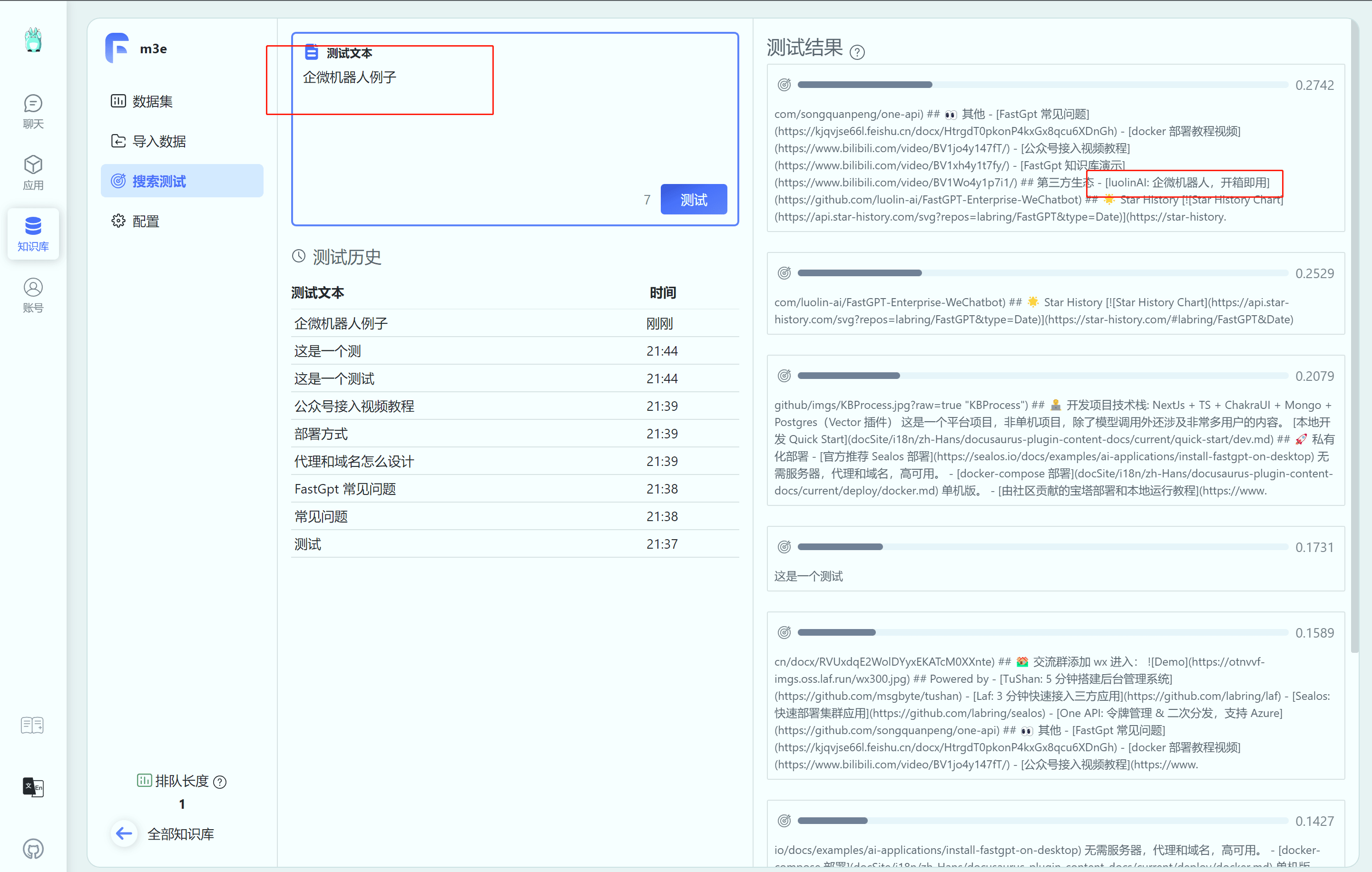
Test search
-
Bind the Knowledge Base to an app
Note: an app can only bind Knowledge Bases that use the same embedding model -- cross-model binding is not supported. You may also need to adjust the similarity threshold, as different embedding models produce different similarity (distance) scores. Test and tune accordingly.

File Updated